Why GFRP Rebars Are the Smart Choice for Coastal and High-Humidity Construction Projects
In India’s tropical and coastal regions, one of the most persistent challenges in construction is corrosion. Structures near the sea or in high-humidity areas face accelerated degradation due to salt-laden air and moisture. Traditional TMT bars, while widely used, are vulnerable to these conditions, leading to rust, reduced strength, and costly repairs.
Enter GFRP rebars (Glass Fiber Reinforced Polymer rebars) — a modern, corrosion-free reinforcement solution that is transforming the way we build. At Dakshin Ultrabar, we specialize in producing high-performance GFRP rebars tailored to tackle these harsh environmental conditions, especially in states like Tamil Nadu, Kerala, Andhra Pradesh, and coastal Karnataka.
In this blog, we explore why GFRP is the ideal alternative to TMT bars in coastal and humid climates, and how it enhances the longevity, safety, and cost-effectiveness of modern structures.
The Problem: Corrosion in Coastal and Humid Regions
TMT steel bars are made of iron and carbon — materials that react aggressively with oxygen and water, especially when chlorides from seawater are present. This leads to:
- Rust formation
- Cracking and spalling of concrete
- Structural weakening
- Increased maintenance and repair costs
- Reduced life span of buildings and infrastructure
In coastal cities like Chennai, Kochi, Mangalore, Visakhapatnam, and others, the high salt content in the atmosphere acts as a continuous corrosive agent. Similarly, places with heavy rainfall or high groundwater tables pose a risk of moisture ingress, attacking the steel inside concrete.
This means even well-designed buildings using TMT bars can suffer premature deterioration — especially in:
- Basements
- ​​​​​​​Water tanks
- Slabs and columns
- Foundations and pile caps
- Bridges and marine structures
The Solution: GFRP Rebars
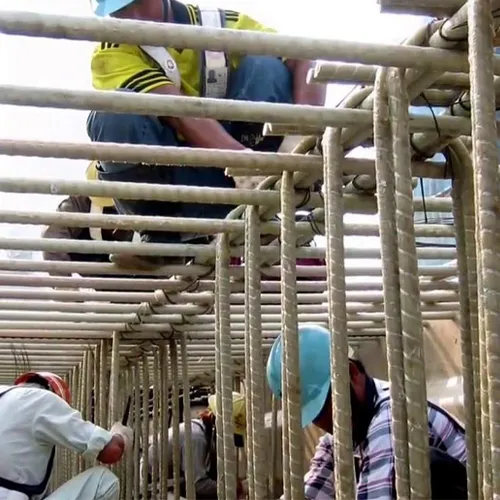
GFRP (Glass Fiber Reinforced Polymer) rebars are made of high-strength glass fibers bonded with a durable polymer resin. This material is engineered to withstand extreme environmental conditions without rusting, expanding, or reacting with chemicals or moisture.
Key Benefits in Coastal and Humid Zones:
- 100% corrosion resistance
- ​​​​​​​No maintenance or coating required
- Lighter than steel – easy to transport and handle
- High tensile strength – often stronger than TMT
- Non-conductive – safe for sensitive installations
- Longer structural life span
1. Total Corrosion Resistance
Unlike steel, GFRP contains no metal. This makes it completely immune to:
- Saltwater
- Moisture
- Acids
- ​​​​​​​Alkaline environments
In structures exposed to coastal air or monsoon conditions, TMT bars begin to rust even before concrete curing completes if not handled properly. GFRP, on the other hand, ensures that your structure remains structurally sound for decades, without the threat of internal corrosion.
2. Reduced Lifecycle Costs
Although GFRP bars may have a slightly higher initial cost than standard TMT bars, they eliminate recurring maintenance such as:
- Corrosion patching
- Concrete repairs
- Rebar replacement
- ​​​​​​​Coating or epoxy treatments
Over the life of the structure, this translates to significant cost savings. For infrastructure projects like bridges, piers, jetties, and multi-storey residential buildings, GFRP delivers better ROI (Return on Investment).
3. Lightweight and Easy Handling
GFRP bars are about 75% lighter than steel, making them easier to:
- Transport to remote or hill/coastal sites
- ​​​​​​​Carry up multiple storeys manually
- Bend and install with minimal labor
This is a huge advantage in humid coastal areas where accessibility is limited and handling heavy steel bars adds to project delays.
4. Compatibility with Concrete
GFRP bars have low thermal expansion, similar to concrete. Unlike TMT bars, which expand and contract more rapidly under heat or moisture, GFRP bars maintain dimensional stability. This reduces:
- Cracking of concrete
- Displacement of internal reinforcements
- Long-term stress development inside the structure
Also, modern GFRP rebars come with ribbed or sand-coated surfaces that ensure excellent bonding with concrete, matching or exceeding the performance of steel rebar in terms of structural adhesion.
5. Safety in Electrical and EMI-Sensitive Zones
In coastal areas, structures like hospitals, airports, and power stations require special construction materials to prevent electromagnetic interference (EMI).
TMT bars are conductive and can interfere with:
- Medical imaging equipment
- Communication networks
- Control panels
GFRP is non-conductive and non-magnetic, making it a perfect fit for:
- MRI rooms
- Substations
- Airport terminals
- High-tech labs
6. Versatile Use Cases in Coastal Construction
At Dakshin Ultrabar, our GFRP rebars are used in a wide range of coastal and humid zone projects including:
âœ”ï¸ Marine Structures:
- Jetties
- Ports
- Breakwaters
- Sea walls
âœ”ï¸ Buildings Near the Coast:
- Residential towers
- Villas
- Hotels and resorts
- Coastal offices
âœ”ï¸ Water Infrastructure:
- STPs and WTPs
- Underground sumps
- Overhead tanks
- ​​​​​​​Drainage systems
âœ”ï¸ Transportation:
- Bridges and flyovers
- ​​​​​​​Railway platforms
- Highway medians and culverts
Why Choose Dakshin Ultrabar for GFRP Rebars
We are one of South India’s most trusted GFRP manufacturers, with:
- A state-of-the-art facility near Coimbatore
- ​​​​​​​Advanced testing labs for consistent quality
- Custom GFRP bends and sizes as per site requirements
- Supply capability across Tamil Nadu, Kerala, Karnataka, and Andhra Pradesh
At Dakshin Ultrabar, our commitment to innovation, quality, and on-time delivery ensures your project stays future-ready — especially in challenging coastal and high-humidity zones.
Conclusion: Build Smarter in Harsh Environments
When it comes to coastal or high-humidity construction, choosing the right reinforcement material is not just about upfront costs — it’s about ensuring long-term safety, performance, and value.
TMT bars may serve short-term needs, but in corrosive environments, GFRP rebars are the superior choice. They help avoid hidden costs, maintenance headaches, and structural failures.
Dakshin Ultrabar’s GFRP rebars are engineered to meet the toughest challenges of coastal and humid construction — making them the smartest reinforcement solution for modern builders, developers, and infrastructure companies.
