GFRP vs TMT Bars: Which Is Better for Modern Construction?
In India’s booming construction landscape, the choice of reinforcement material is critical. While TMT (Thermo-Mechanically Treated) steel bars have long been the standard in reinforced concrete structures, new challenges — such as corrosion, sustainability, and electromagnetic interference — are pushing the industry to look for better alternatives.
Enter GFRP (Glass Fiber Reinforced Polymer) rebars, a cutting-edge reinforcement solution that’s steadily replacing steel in many key infrastructure projects.
At Dakshin Ultrabar, we specialize in manufacturing high-performance GFRP rebars designed to meet the evolving demands of construction professionals across Tamil Nadu, Kerala, Karnataka, and Andhra Pradesh. In this blog, we explore the key differences between GFRP and TMT bars — and help you decide which one suits your next project.
What Are GFRP and TMT Bars?
TMT Bars (Thermo-Mechanically Treated Steel Bars):
TMT bars are high-strength reinforcement bars made by a controlled heat treatment process. They offer good tensile strength and ductility and are widely used in all types of RCC (Reinforced Cement Concrete) structures.
GFRP Rebars (Glass Fiber Reinforced Polymer Rebars):
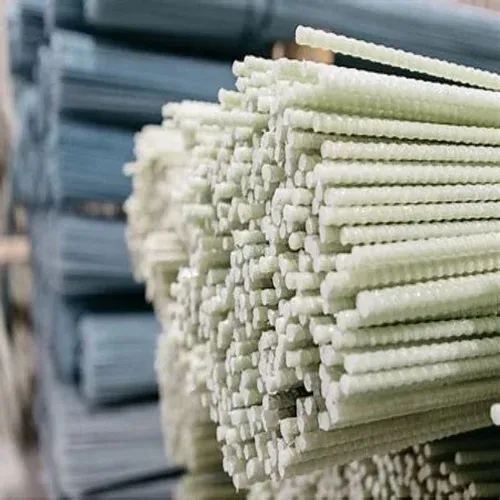
GFRP rebars are non-metallic reinforcements made from glass fibers embedded in a polymer resin. They’re corrosion-resistant, lightweight, and non-magnetic — ideal for challenging environments.
GFRP vs TMT: A Detailed Comparison
|
Feature |
GFRP Rebars |
TMT Steel Bars |
|
Material |
Glass fibers + Polymer resin |
Thermo-mechanically treated steel |
|
Corrosion Resistance |
100% corrosion-free |
Prone to rust in moist, coastal, or saline conditions |
|
Weight |
~75% lighter than steel |
Heavy |
|
Tensile Strength |
High (up to 1000 MPa) |
High (415-600 MPa) |
|
Modulus of Elasticity |
Lower (requires different design approach) |
Higher |
|
Conductivity |
Non-conductive, non-magnetic |
Conductive and magnetic |
|
Durability |
2–3 times longer life in corrosive zones |
Shorter lifespan in harsh environments |
|
Bond with Concrete |
Good with sand-coated surface |
Naturally strong bond |
|
Thermal Expansion |
Similar to concrete |
Higher than concrete |
|
Lifecycle Cost |
Low (due to zero maintenance) |
High (due to corrosion, repairs) |
|
Initial Cost |
Slightly higher |
Lower upfront cost |
|
Suitability |
Ideal for marine, chemical, infrastructure, EMI-sensitive sites |
Universal use in most traditional structures |
1. Corrosion Resistance
TMT bars are highly susceptible to rust, especially in coastal regions, underground foundations, or chemical plants. Over time, corrosion leads to cracking, spalling, and structural weakness.
GFRP rebars, on the other hand, do not corrode, even in harsh environments. This makes them ideal for:
- Marine structures
- Bridges
- Basements
- Water tanks
- Coastal construction
2. Weight and Handling
TMT bars are dense and heavy, which increases transportation, labor, and crane costs.
GFRP rebars are about 75% lighter, reducing handling effort, installation time, and labor fatigue on-site. A lighter material also means reduced dead load on the structure.
3. Tensile Strength
GFRP rebars provide tensile strength comparable or higher than TMT bars, but have a lower modulus of elasticity. This means they stretch more under load and require revised design parameters.
When used correctly, GFRP performs exceptionally in:
- Bridge decks
- Load-bearing slabs
- Retaining walls
4. Electrical and Magnetic Properties
In applications like:
- MRI rooms
- Airports
- Power substations
- Electronic equipment rooms
Steel’s electromagnetic conductivity is a problem.
GFRP is non-conductive and non-magnetic, making it perfectly safe for EMF-sensitive construction.
5. Durability and Service Life
TMT bars in harsh environments need:
- Protective coatings
- Periodic inspections
- Costly repairs or replacements
GFRP rebars last 2 to 3 times longer, reducing lifecycle costs and enhancing structure longevity.
6. Application Suitability
While TMT bars are universally used in regular residential and commercial construction, they are not suited for:
- Marine structures
- Acidic soils
- Chloride-rich environments
GFRP rebars shine in:
- Bridges and flyovers
- Coastal and offshore structures
- Water tanks and treatment plants
- Substations and MRI buildings
Cost Factor: GFRP vs TMT
- Initial Cost: TMT is cheaper per unit.
- Installation Cost: GFRP wins (less labor and equipment needed).
- Maintenance Cost: TMT needs regular inspection and corrosion treatment. GFRP needs none.
- Total Lifecycle Cost: GFRP is more cost-effective in the long run.
Use Cases in the Indian Construction Landscape
|
Project Type |
Recommended Rebar |
|
Apartment buildings in city |
TMT |
|
Villas near beach/coastal areas |
GFRP |
|
Marine ports and seawalls |
GFRP |
|
Industrial flooring exposed to chemicals |
GFRP |
|
Metro tunnels and underground tanks |
GFRP |
|
Flyovers, highway bridges, foot overbridges |
GFRP |
|
MRI rooms or EMI-sensitive structures |
GFRP |
Dakshin Ultrabar: Leading the GFRP Revolution
At Dakshin Ultrabar, we understand the demands of modern construction. Our state-of-the-art facility near Coimbatore is dedicated to the production of custom GFRP rebars and bent elements, ensuring:
- Uniform quality
- Project-specific solutions
- Timely delivery across South India
- Excellent bond strength with concrete
Whether you're building a bridge, basement, or water tank, our GFRP rebars ensure lasting performance and peace of mind.
Conclusion:
If you're working on a conventional building in a low-risk environment, TMT bars may serve your needs.
However, for marine, industrial, underground, or infrastructure projects — where corrosion, conductivity, and maintenance are major concerns — GFRP rebars are the clear choice.
The construction industry is evolving, and materials like GFRP are paving the way for stronger, smarter, and more sustainable structures. Build for the future with Dakshin Ultrabar’s GFRP rebars.
